
von
When you look at a basket of blueberries, concord grapes, the head of red cabbage, red potatoes or bright red strawberries you’re looking at polyphenols—a massive family of protective plant compounds. Specifically, these vivid red, purple, and blue colors belong to a sub-group called flavonoids. And the main molecule responsible for those deep, rich hues is a specific pigment class named anthocyanins.
Blueberries and Concord Grapes: These are very well known foods containing anthocyanins. They get their deep purplish-blue color from high concentrations of anthocyanin compounds like delphinidin, malvidin and petunidin.[1,2]

Blackberries and Elderberries: The dark color of these two berries is due to the heavy predominance of the cyanidin molecule. Analysis has measured cyanidin derivatives at over 80% of total anthocyanins in blackberries and over 90% in elderberries. [3,4]

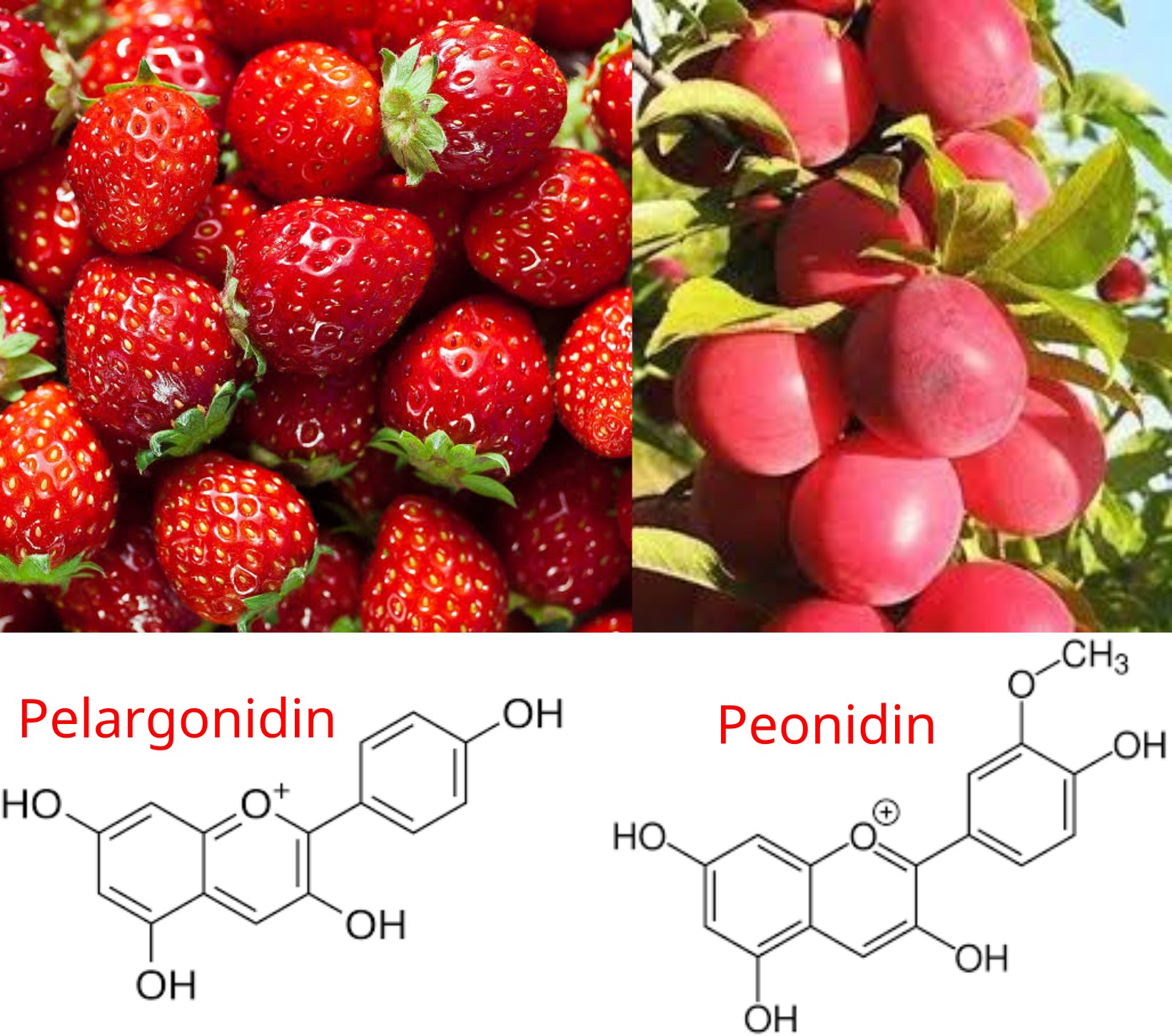
In strawberries, the bright scarlet red pigment is predominantly driven by the anthocyanin pelargonidin . Profiling of ripening cultivars reveals that this single pelargonidin compound accounts for approximately 92% of the fruit’s total anthocyanin content, with cyanidin derivatives making up only a minor fraction. Consequently, strawberries stand out as the most significant dietary source of pelargonidin among all common fruits. [5,6]
In red plums (Prunus domestica L.), the anthocyanin peonidin plays a key role in developing their distinct reddish-magenta skin tone. Along with cyanidin derivatives, these peonidin compounds accumulate in the fruit skin as it ripens, driving both the fruit’s rich pigmentation and its antioxidant properties [7,8]

Summary: Nature’s Six Core Anthocyanian Molecular Toolkit
Below in Figure 4 is a summary of the series. While there are hundreds of different anthocyanins in nature, virtually all of them are built on just six primary aglycone backbones (anthocyanidins).
As shown in the diagram, every single one shares the exact same flavylium core structure—the only difference lies in what nature attaches to the R1 and R2 positions:

From Structure to Function:
While our discussion has focused on the six primary anthocyanidin aglycones, these core backbones seldom exist in isolation within plant tissues. In vivo, they are almost universally conjugated with sugar moieties—such as glucose, galactose, or rhamnose—to form fully functional anthocyanins.
This glycosylation is biochemically essential for two key reasons:
- Structural Stability & Solubility: Binding to a sugar molecule stabilizes the reactive flavylium core, preventing degradation and enhancing water solubility within the plant cell’s vacuole.
- Chromatic Diversity: The precise configuration of these sugar attachments, often combined with acylation and local vacuolar pH, dictates light absorption and gives rise to the extensive spectrum of plant pigmentation observed in nature.
The physiological role of these sugar conjugates extends far beyond plant coloration, however. Their specific structural configurations play a critical role in human metabolism. In upcoming articles, we will examine how glycosylation influences the digestion, intestinal absorption, and overall bioavailability of anthocyanins and related polyphenols.
Bibliography
[1] Overall et al., Metabolic Effects of Berries with Structurally Diverse Anthocyanins, International Journal of Molecular Sciences, 18(2), 422, 2017.
[2] Wang et al., Blueberry (Vaccinium spp.) Anthocyanins and Their Functions, Stability, Bioavailability, and Applications, Foods, 13(17), 2851, 2024.
[3] Lee et al., Assessment of Six Blackberry Cultivars Using a Combination of Metabolomics, Biological Activity, and Network Pharmacology Approaches, Antioxidants, 13(3), 319, 2024.
[4] Haș et al., Bioactive Potential of Elderberry (Sambucus nigra L.): Antioxidant, Antimicrobial Activity, Bioaccessibility and Prebiotic Potential, Molecules, 28(7), 3099, 2023.
[5] Griesser et al., Redirection of Flavonoid Biosynthesis through the Down-Regulation of an Anthocyanidin Glucosyltransferase in Ripening Strawberry Fruit, Plant Physiology, 146(4), 1528–1539, 2008.
[6] Agarwal et al., Pelargonidin and Berry Intake Association with Alzheimer’s Disease Neuropathology A Community-Based Study, Journal of Alzheimer’s Disease, 88(2), 653–661, 2022.
[7] Trendafilova et al., Chemical Composition and Antioxidant Capacity of the Fruits of European Plum Cultivar “Čačanska Lepotica” Influenced by Different Rootstocks, Foods, 11(18), 2844, 2022.
[8] Mieszczakowska-Frąc et al., Effect of Postharvest Ripening on the Phytochemical Composition and Antioxidant Properties of Fruits from Ten Plum (Prunus domestica L.) Cultivars, Agronomy, 15(6), 1351, 2025.
[9] Kay, Aspects of anthocyanin absorption, metabolism and pharmacokinetics in humans, Nutrition Research Reviews, 19(1), 137–146, 2006.