
von
If you’ve ever admired the deep purple of a blueberry or grape, the vibrant red of a strawberry, or the dark ruby hues of red cabbage, you’ve looked directly at one of evolution’s most versatile chemical developments: anthocyanins.

Aside from making fruits and vegetables visually appealing, these vibrant pigments serve a far more functional purpose. For plants, anthocyanins are survival tools—built out of simple atoms found in air and water—to defend against severe stress. And when we consume them, our own bodies utilize those exact same intact molecules to protect our cells, calm systemic inflammation, and optimize blood vessel expansion through nitric oxide (NO) pathways[1, 2].
1. Crafted from Air, Water, and Sunlight
Plants are extraordinary chemical factories. Photosynthesis is widely known as the process plants utilize sunlight as an energy source to turn carbon dioxide (CO2) from the air and hydrogen and oxygen (in the form of water, H2O) from the soil into simple sugars. But sugar creation is just the beginning. The light energy harvested through photosynthesis powers numerous other biosynthetic pathways, allowing the plant to construct a vast suite of complex molecules [3, 4].

When a plant experiences environmental stress—such as intense sunlight, cold snaps, or nutrient scarcity—it redirects its photosynthetic energy. Instead of using all its fixed carbon to build simple sugars for routine growth, the plant shunts carbon, hydrogen, and oxygen into specialized metabolic pathways (primarily the phenylpropanoid pathway). Here, these basic atoms are assembled into complex, aromatic ring structures known as flavonoids [5,6].
2. Adaptive Chemistry: How Anthocyanins Guard Plant Cells
Among the thousands of flavonoids found in nature, anthocyanins represent a uniquely vital subclass. They are the water-soluble pigments specifically synthesized to act as potent molecular shields, giving plants their vibrant red, purple, and blue hues while protecting delicate cellular machinery from:
1) ultraviolet irradiation
2) temperature extremes
3)drought-induced dehydration .
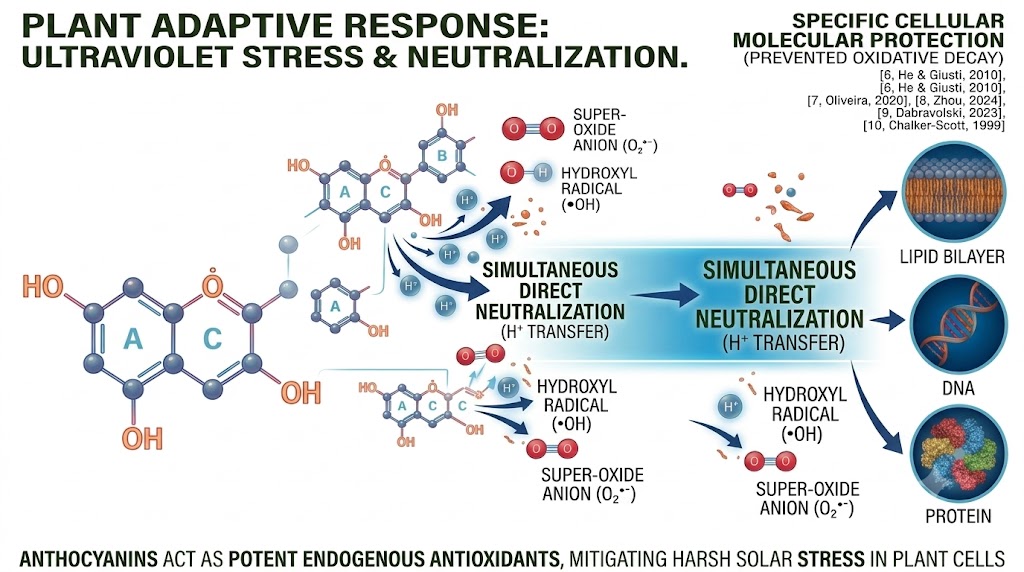
Ultraviolet Irradiation: Anthocyanins deploy a sophisticated dual-defense strategy against solar radiation. First, they accumulate within epidermal tissues to function as an optical filter, absorbing high-energy UV photons before they can penetrate deeper into the leaf and disrupt photosynthetic machinery. [7, 10] Simultaneously, when excess UV exposure inevitably generates damaging reactive oxygen species (ROS), anthocyanins act as potent endogenous antioxidants. By rapidly neutralizing these free radicals, they prevent DNA damage, lipid peroxidation, and protein degradation, allowing the plant to maintain cellular integrity even under harsh solar stress [6,7, 8].

Temperature Extremes: Anthocyanins safeguard plant tissues against thermal stress caused by both extreme cold and excessive heat. During cold exposure and freezing conditions, they function as osmoprotectants, altering cellular fluid dynamics to depress the freezing point and prevent membrane damage or intracellular ice formation. Under heat stress, where elevated temperatures accelerate metabolic decay and destabilize cellular machinery, anthocyanins reinforce membrane integrity and quench heat-induced reactive oxygen species (ROS), preserving photosynthetic function through severe climate fluctuations [8, 9, 10]
Osmotic Stress: Anthocyanins play a critical role in mitigating water scarcity and soil hypersalinity. During severe drought or high-salt conditions, plants suffer from osmotic dehydration and intracellular ionic imbalance. Anthocyanins act as organic osmolytes, helping maintain cellular internal water pressure and water retention while simultaneously scavenging ROS produced under metabolic strain. By stabilizing cell membranes and regulating stomatal behavior, anthocyanins prevent tissue desiccation and preserve metabolic function during prolonged osmotic stress [9, 10].
3. Plant Defense to Human Health: How Anthocyanins Protect Our System
The very mechanisms that make anthocyanins indispensable for plant survival—their potent antioxidant capability, cellular signaling influence, and anti-inflammatory action—translate directly to the human system. When we consume anthocyanin-rich foods like berries, dark grapes, and red cabbage, these compounds interact directly with our physiology. Once absorbed into the human digestive system, anthocyanins provide comparable cellular protection, offering broad benefits at the cellular and systemic levels.
Cardiovascular Health & Endothelial Function
Anthocyanins significantly improve cardiovascular performance by enhancing endothelial function and microvascular health. Upon entering circulation, they stimulate endothelial nitric oxide synthase (eNOS), increasing nitric oxide production to promote vasodilation, reduce arterial stiffness, and help regulate blood pressure [2]. Additionally, their antioxidant properties inhibit the oxidation of low-density lipoproteins (LDL) and reduce vascular cell adhesion molecules, mitigating the early stages of atherosclerosis and vascular inflammation [1, 2, 7].
Neuroprotection & Cognitive Support
Anthocyanins and their metabolites are capable of crossing the blood-brain barrier to exert direct neuroprotective effects[11, 12, 13]. In the central nervous system, they mitigate neuroinflammation and protect neuronal structures from chronic oxidative stress. By supporting cerebral blood flow and modulating key signal transduction pathways involved in neuronal survival, dietary intake of anthocyanins has been shown to support memory retention, cognitive processing, and overall brain longevity [1, 7, 11, 12, 13].
Metabolic Regulation & Glycemic Control
Within metabolic tissues, anthocyanins influence carbohydrate metabolism and cellular energy balance. They inhibit key digestive enzymes (such as alpha-glucosidase and alpha-amylase), which slows glucose absorption in the gut and prevents post-meal blood sugar spikes. Furthermore, they enhance insulin sensitivity by activating AMP-activated protein kinase (AMPK) in muscle and liver tissues, supporting glucose uptake and reducing the risk of metabolic dysfunction [1, 5, 7].
Systemic Antioxidant Defense & ROS Scavenging
At the cellular level, anthocyanins serve as exceptionally potent scavengers of reactive oxygen species (ROS). Their chemical structure—rich in hydroxyl groups—allows them to directly donate hydrogen atoms to neutralize free radicals such as superoxide anions and hydrogen peroxide before they can trigger cellular damage [1, 7]. Beyond direct neutralization, anthocyanins upregulate endogenous antioxidant enzymes like superoxide dismutase (SOD) and catalase, mitigating systemic oxidative stress and protecting lipids, proteins, and DNA from oxidative decay throughout human tissues [1, 7, 12].
4. Summary
Driven by photosynthetic energy, plants redirect basic carbon, hydrogen, and oxygen atoms into metabolic pathways to synthesize anthocyanins—vibrant pigments that act as crucial survival tools. Rather than serving a single purpose, anthocyanins deploy a broad defense system against environmental strain: they filter harmful ultraviolet radiation, function as cryoprotectants and heat stabilizers during temperature extremes, and maintain cellular water pressure during severe drought or salinity. Across all these conditions, they actively scavenge damaging reactive oxygen species (ROS), preserving plant cell integrity under harsh climate conditions.
When we consume anthocyanin-rich foods, these exact plant defense molecules offer direct, parallel protection within human physiology. At the cellular level, their potent antioxidant structure quenches free radicals and boosts our body’s own protective enzymes, shielding DNA, proteins, and cell membranes from oxidative decay. Systemically, this translates into broad health benefits—supporting cardiovascular performance through improved blood flow, protecting brain tissue against neuroinflammation, and aiding metabolic balance by regulating blood sugar. Ultimately, the very chemical shields built for plant survival serve as vital defenders of human health.
Bibliography
[1] He J, et al., Anthocyanins: natural colorants with health-promoting properties, Annu Rev Food Sci Technol, 1, 163–187, 2010.
[2] Xu JW, et al., Upregulation of endothelial nitric oxide synthase by cyanidin-3-glucoside, a typical anthocyanin pigment, Hypertension, 44(2), 217–222, 2004.
[3] Thoma F, et al., Effects of Light on Secondary Metabolites in Selected Leafy Greens: A Review, Front. Plant Sci., 11, 497, 2020.
[4] Wu W, et al., Light regulates the synthesis and accumulation of plant secondary metabolites, Front Plant Sci, 16, 1644472, 2025.
[5] Zhao X, et al., Regulation Mechanism of Plant Pigments Biosynthesis: Anthocyanins, Carotenoids, and Betalains, Metabolites, 12(9), 871, 2022.
[6] Mao Y, et al., Biosynthesis and Regulatory Mechanisms of Plant Flavonoids: A Review, Plants (Basel), 14(12), 1847, 2025.
[7] Oliveira H, et al., Exploring the Applications of the Photoprotective Properties of Anthocyanins in Biological Systems, International Journal of Molecular Sciences, 21(20), 7464, 2020.
[8] Zhou B, et al., The ncRNAs Involved in the Regulation of Abiotic Stress-Induced Anthocyanin Biosynthesis in Plants, Antioxidants, 13, 55, 2024.
[9] Dabravolski SA, et al., The Role of Anthocyanins in Plant Tolerance to Drought and Salt Stresses, Plants (Basel), 12(13), 2558, 2023.
[10] Chalker-Scott L, et al., Environmental Significance of Anthocyanins in Plant Stress Responses, Photochemistry and Photobiology, 70, 1–9, 1999.
[11] Henriques JF, et al., The Anti-Neuroinflammatory Role of Anthocyanins and Their Metabolites for the Prevention and Treatment of Brain Disorders, Int J Mol Sci, 21(22), 8653, 2020.
[12] Zaa CA, et al., Anthocyanins: Molecular Aspects on Their Neuroprotective Activity, Biomolecules, 13(11), 1598, 2023.
[13] Faria A, et al., Flavonoid transport across blood-brain barrier Implication for their direct neuroprotective actions, Nutrition and Aging, 1(3-4), 213–224, 2012.